


Usability findings are powerful, but only when the organization understands what to do with them.
Most teams collect observations. Fewer turn those observations into decisions that change revenue, reduce cost, or protect customer trust. The gap is not skill. The gap is translation.
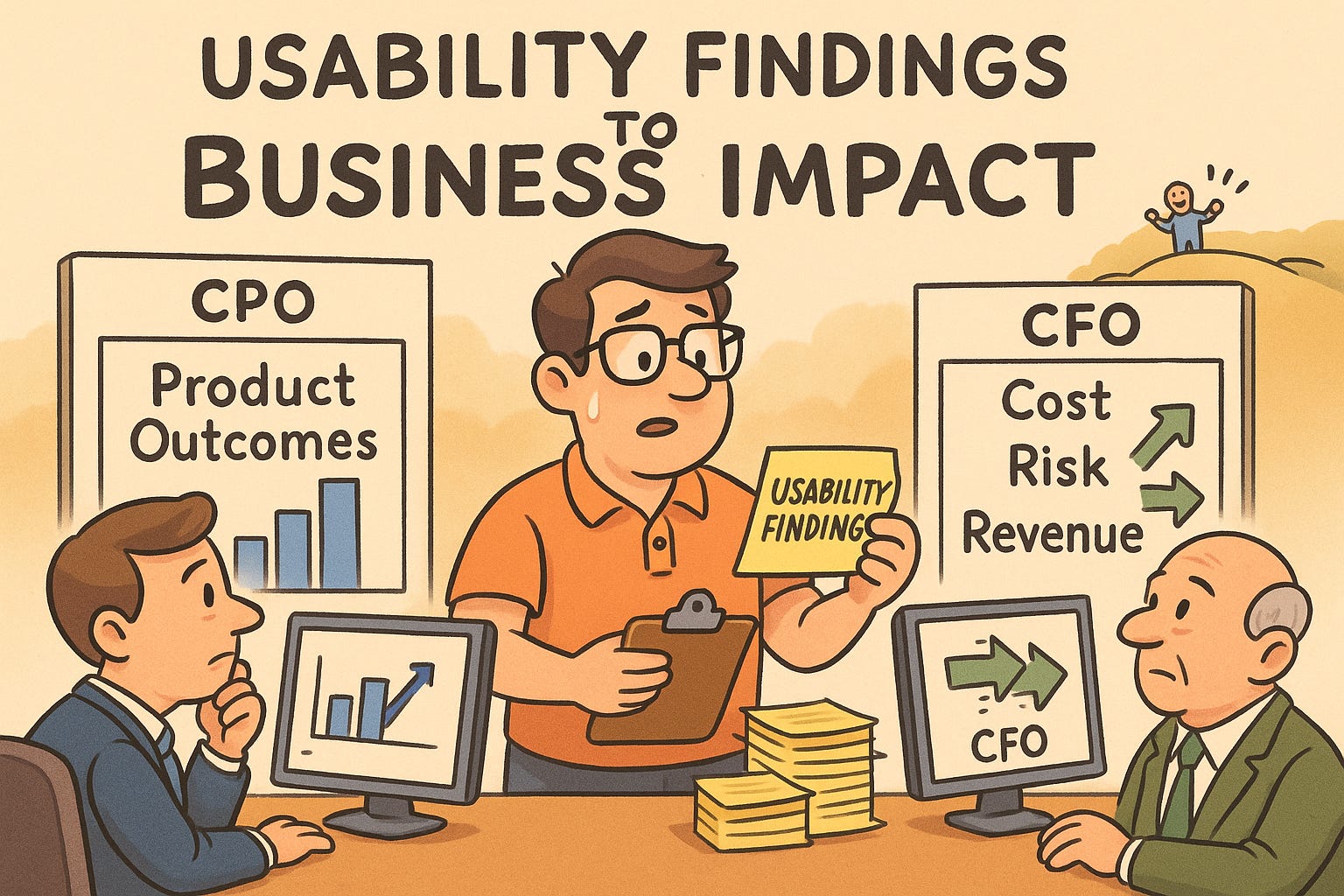
This issue shows how to convert usability insights into actions that matter to people who make business calls, especially roles like the CPO (Chief Product Officer) and CFO (Chief Financial Officer).
A CPO cares about product outcomes.
A CFO cares about cost, risk, and revenue.
When your findings speak to their priorities, decisions move faster.
In This Issue
• Why usability findings stall
• The three-part translation formula
• How to frame insights so decision makers listen
• Examples
• Common mistakes
• Resource Corner
Join Don Norman at UXCON26
This year, we will be joined by Don Norman, a voice many of us first met through his books, talks, and foundational ideas about design.

His work shaped the field long before UX had a familiar name.
His ideas changed how teams build products.
His writing brought clarity where there was confusion.
His thinking continues to guide designers, researchers, engineers, and leaders around the world.
Having him with us at UXCON26 is an honor.
Join us, learn from a legend, and experience what the future of UX can be.
Why usability findings stall
Usability findings often stop at the surface.
Teams present what happened. Leadership wants to know why it matters.
Example:
“Users struggled to complete onboarding.”
Leadership questions:
• What does it cost us
• What KPI does this affect
• What is the size of the opportunity
• What decision should we make now
Decision makers are not rejecting insights.
They are waiting for the business connection.
The three-part translation formula
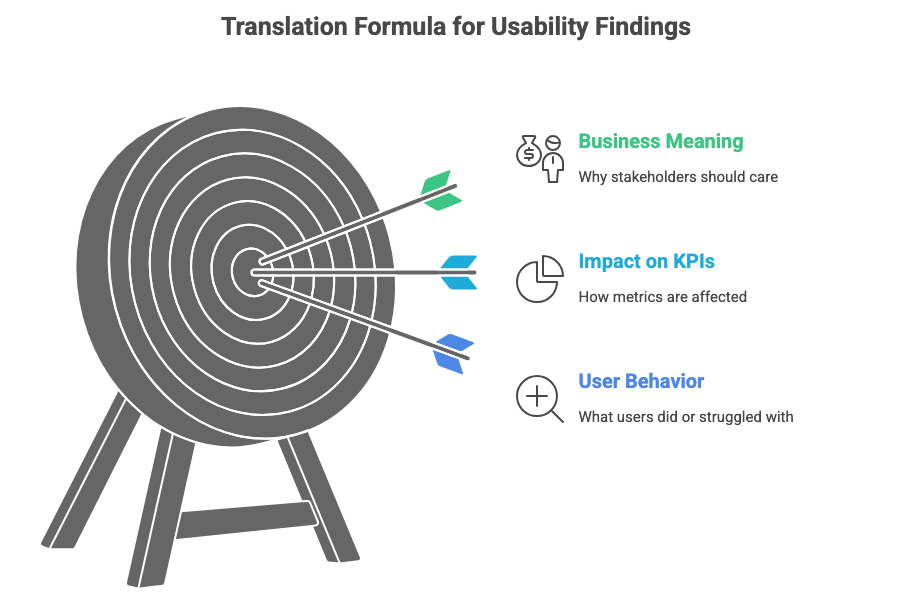
Turn every usability finding into this simple pattern.
1. User Behavior
What users did or struggled with.
Example: “Users cannot find the upload button on mobile.”
2. Impact on KPIs
Which metric changes because of this.
Example: “This directly affects activation and first-run success.”
3. Business Meaning
Why the CPO or CFO should care.
Example: “Poor activation hurts retention and increases support tickets.”
This is the bridge between observation and action.
How to frame insights so decision makers listen
Use the language they understand.
If you are presenting to a CPO (Chief Product Officer):
The CPO owns product outcomes and growth.
They want to know:
• How does this affect the product’s performance
• What user behavior will improve if we fix this
• What decision unblocks the team fastest
CPO-style framing:
“Users abandon the flow at step three. A one-screen redesign could recover activation and increase adoption of Feature A.”
If you are presenting to a CFO (Chief Financial Officer):
The CFO protects company money and evaluates risk.
They want:
• Cost saved
• Risk avoided
• Revenue unlocked
CFO-style framing:
“Hiding the upload button increases support tickets by 12 percent per month. A minor redesign will reduce support workload and prevent repeat errors.”
When you speak both languages, your insights land with both product and finance.
Examples you can borrow
Example 1: Checkout friction
Finding: “Users hesitate when shipping fees appear late.”
KPI: Completed orders.
Business meaning: Transparent pricing improves conversions.
Decision: “Move fee preview earlier. Small front-end change.”
Example 2: Onboarding confusion
Finding: “Users skip key steps because labels are unclear.”
KPI: Activation and retention.
Business meaning: Fewer successful onboardings means fewer long-term users.
Decision: “Clarify labels and reduce unnecessary fields.”
Example 3: High-support feature
Finding: “Users repeatedly ask support how to find downloaded files.”
KPI: Support load and cost to serve.
Business meaning: This drains time and increases cost.
Decision: “Add a dedicated ‘Downloads’ tab and tooltips.”
Example 4: Failed app permissions
Finding: “Users deny permissions because explanations are vague.”
KPI: Feature usage.
Business meaning: If users cannot enable permissions, the feature cannot deliver value.
Decision: “Rewrite permission prompts in plain language.”
These examples convert raw friction into business clarity.
Common mistakes
• Presenting long lists of findings with no prioritization
• Sharing problems without suggesting decisions
• Focusing on UX pain points instead of KPI movement
• Using only UX language, not business language
• Assuming the team will know why a finding matters
Your job is not only to uncover friction.
Your job is to convert friction into actionable business moves.
Resource Corner
Prioritizing usability fixes
NNGroup – Severity ratings for usability problems
https://www.nngroup.com/articles/how-to-rate-the-severity-of-usability-problems/
Turning Usability Testing Data into Action without Going Insane
How To Analyze Usability Test Results Like A Pro In 2025
Final Thought
Usability findings become powerful when they drive choices, not conversations.
If you show what users struggled with, which KPI it affects, and what decision moves the business forward, you stop being a presenter of insights and become a partner in strategy.
Business decisions are simply usability findings with direction.


