


Good UX feels valuable, but value becomes undeniable when you can measure it.
Teams move faster when they understand the impact a UX improvement creates.
A UX Impact Calculator helps you translate design changes into numbers that matter. It turns intuition into evidence and helps people see the real effect of your work.
In This Issue
• Why UX impact needs measurement
• The three numbers to collect
• A simple impact formula
• How to explain the result
• Examples
• Common mistakes
• Resource Corner
Why UX impact needs measurement
Without numbers, UX conversations become subjective.
UX impact is the positive change created by a UX improvement.
UX impact means a measurable result, like more people completing a task or fewer errors happening.
When impact becomes visible, people understand why a change matters.
A calculator makes this easy.
Don Norman is coming to UXCON26
This year, we will be joined by Don Norman, a voice many of us first met through his books, talks, and foundational ideas about design.
His work shaped the field long before UX had a familiar name.
His ideas changed how teams build products.
His writing brought clarity where there was confusion.
His thinking continues to guide designers, researchers, engineers, and leaders around the world.
Having him with us at UXCON26 is an honor.
Join us, learn from a legend, and experience what the future of UX can be.
The three numbers you need
A UX Impact Calculator only requires three simple inputs.
1. How many people reach the moment you want to improve
This is your volume.
Volume means the number of users affected by a UX issue or improvement.
2. How often the problem or behavior happens
This is your behavior change estimate.
Behavior change means the shift you expect when UX improves the experience.
3. What each successful behavior is worth
This is your value per behavior.
Value per behavior means the benefit created when a user completes the intended action.
These three inputs unlock the calculation.
The simple formula
Impact = Volume × Behavior Change × Value per Behavior
Example:
100,000 users × 0.05 behavior improvement × 15 dollars value
= 75,000 dollars unlocked
This turns a design fix into a measurable win.
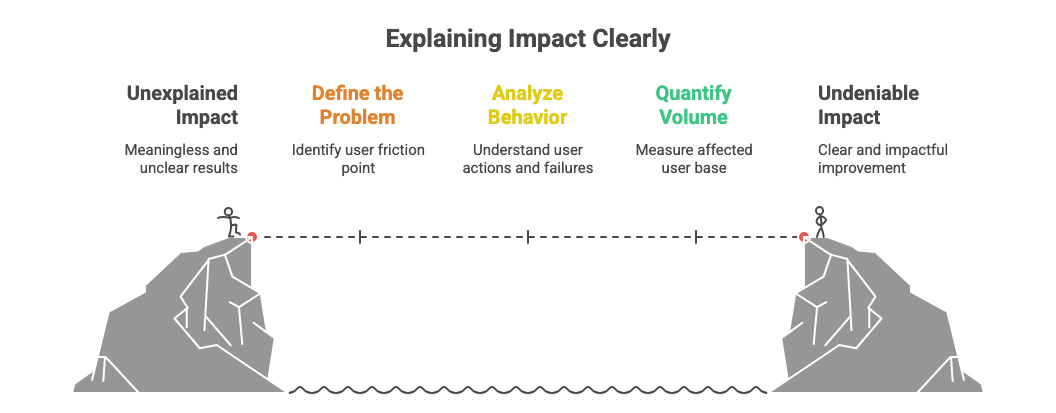
How to explain the result
Impact becomes meaningful when it is explained clearly.
Use this structure:
1. The problem
“Users drop off when the total cost appears late.”
2. The behavior affected
“This causes 9 percent of people to abandon checkout.”
Behavior means what users do or fail to do when friction appears.
3. The volume affected
“About 100,000 people reach checkout every month.”
4. The value per success
“Each completed checkout is worth 15 dollars.”
Value means the outcome created when the user succeeds.
5. The impact estimate
“This change could unlock about 75,000 dollars a month.”
Now the improvement becomes undeniable.
Examples you can borrow
Example 1: Confusing navigation
Problem: Users cannot find order tracking.
Volume: 7,000 users per month
Behavior loss: 25 percent
Value per behavior: 1 dollar in avoided support cost
Impact: 7,000 × 0.25 × 1 = 1,750 dollars per month
Example 2: Low onboarding completion
Problem: Users skip a key step.
Volume: 20,000 new users
Behavior change: 10 percent
Value per behavior: 12 dollars
Impact: 20,000 × 0.10 × 12 = 24,000 dollars per month
Example 3: Form confusion
Problem: Users mistype card details.
Volume: 50,000 attempts
Behavior change: 8 percent
Value per behavior: 18 dollars
Impact: 50,000 × 0.08 × 18 = 72,000 dollars per month
Each example turns friction into a measurable number.
Common mistakes
• Overcomplicating the calculation
• Using unrealistic improvement percentages
• Forgeting to define the value per behavior
• Not showing how the number was calculated
• Only showing the final amount without the context behind it
A good calculator is simple, believable, and repeatable.
Resource Corner
How to Measure UX Research Impact (Free Template)
UX ROI Calculator !! Check your UX efficiency
Final Thought
You do not need perfect data to show meaningful impact.
You need a simple way to estimate how your work helps people succeed.
A UX Impact Calculator turns design decisions into measurable outcomes.
Once people see the numbers, they understand the value.


