


If you want UX to influence budgets, you have to speak the language of the person who controls them.
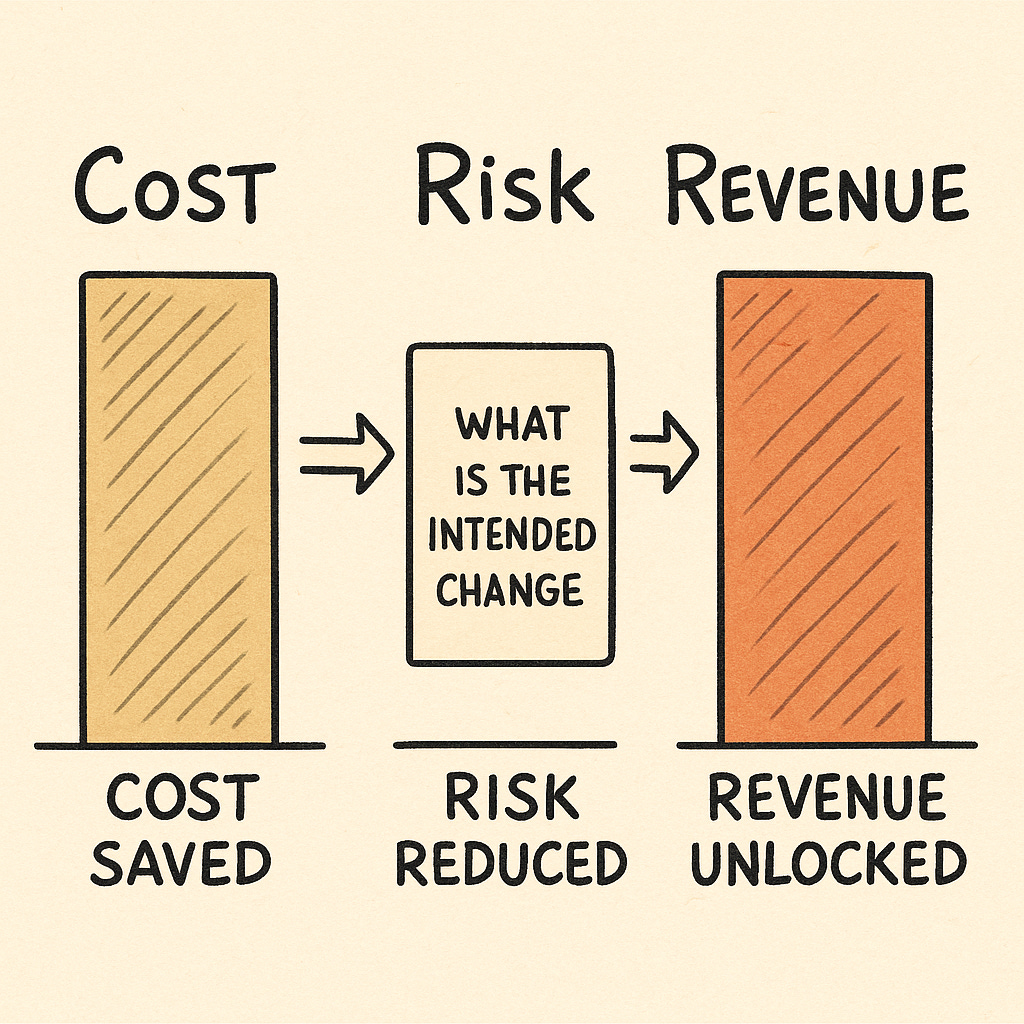
CFOs think in three dimensions.
Cost. Risk. Revenue.
They are not trying to block UX. They are trying to protect the company’s financial health. When UX arguments map cleanly to these three levers, the conversation changes. You stop defending your work and start shaping investment decisions.
This issue teaches you how to translate UX value into CFO language without losing the human story.
In This Issue
• Why CFOs see the world differently
• The three UX arguments that land every time
• How to translate UX work into money conversations
• Real examples
• Common mistakes
• Resource Corner
BEFORE WE DIVE IN……..
Did you know…..UX is no longer just about good design.
It’s about influence, decision-making, and proving your value in rooms that matter.
UXCON25 helped professionals see that clearly.
Not through theory, but through real stories, real paths, and real conversations about what actually moves a UX career forward today.
UXCON26 is built for the next step.
You’ll learn how experienced UX professionals are staying relevant,
how they’re navigating layoffs, leadership, and shifting expectations,
and how to position yourself for growth in a market that keeps changing.
It’s about leaving with clarity, confidence, and a stronger sense of direction.
If you’re serious about your UX career, UXCON26 is worth the seat.
Why CFOs see the world differently
CFOs are not asking for pixels, flows, or prototypes. They are asking:
• What does this project cost
• What does it prevent
• What does it unlock
They operate inside strict financial cycles, and they focus on the durability of each decision. If you learn how to frame UX in these terms, your work becomes a financial asset instead of a discretionary request.
The three UX arguments CFOs understand immediately
1. Cost Reduction
UX reduces cost in three ways.
• Fewer support tickets
• Less engineering rework
• Lower training or onboarding time
CFOs listen when you show how UX stops the company from overspending.
2. Risk Reduction
Every unclear flow introduces risk.
• Risk of errors
• Risk of compliance issues
• Risk of losing high-value customers
CFOs are trained to respond when a design decision protects the company.
3. Revenue Acceleration
This is the language that unlocks budget quickly.
• Higher checkout completion
• Better free to paid conversion
• Faster onboarding to value
If you can show a path to revenue improvement, the CFO sees UX as fuel for growth.
How to translate UX work into money conversations
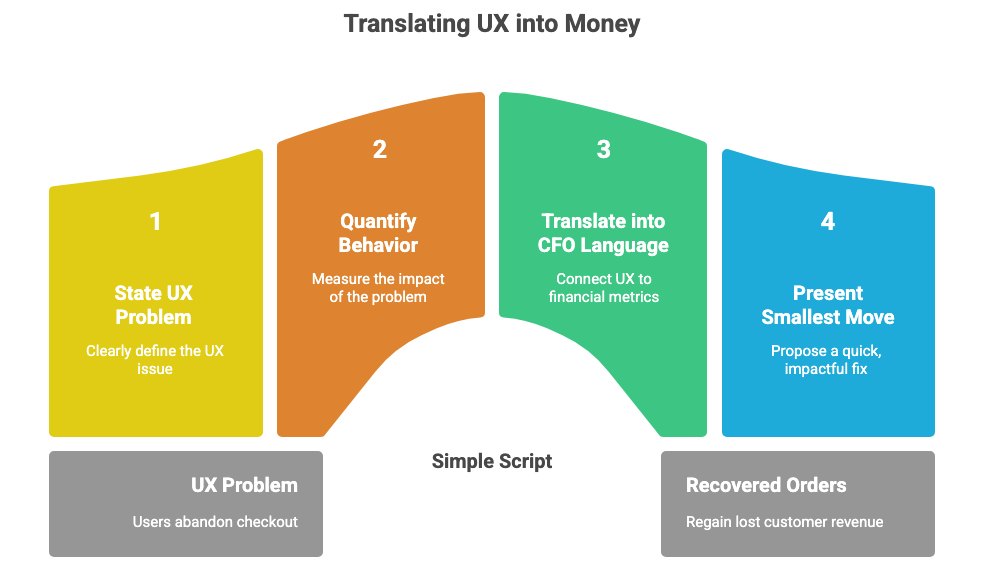
Use this simple script.
1. State the UX problem clearly
Example: “Users abandon checkout at the coupon step.”
2. Quantify the behavior
Example: “Twenty percent of users exit the page when they cannot find the field.”
3. Translate it into CFO language
Cost: “This increases support tickets and refund requests.”
Risk: “We are losing customers before their first purchase.”
Revenue: “A fix could recover 5 to 9 percent of lost orders.”
4. Present the smallest strong move
Example: “Reposition coupon field above total. No engineering refactor needed.”
This script fits on one slide. CFOs like that.
Real examples you can reuse
Support ticket reduction
Insight: Users cannot find invoice history.
Cost lens: Billing tickets cost time and money.
Statement: “A simple navigation fix could reduce billing tickets by 18 percent.”
Engineering rework prevention
Insight: Early tests show confusion around the new dashboard layout.
Risk lens: Shipping this as-is risks four to six weeks of rework.
Statement: “Fixing clarity now avoids expensive backtracking.”
Conversion uplift
Insight: Users hesitate when add-on fees appear late in checkout.
Revenue lens: Transparent pricing increases completed purchases.
Statement: “Clarifying fees upfront could lift conversion by 7 percent.”
Compliance protection
Insight: Users are skipping consent screens because the copy is unclear.
Risk lens: This opens regulatory exposure.
Statement: “Clearer guidance reduces compliance risk and protects reputation.”
When you speak cost, risk, and revenue, your insights travel much further.
Common mistakes
• Explaining design decisions without showing financial stakes
• Focusing on aesthetics instead of business impact
• Sharing too many metrics at once
• Using jargon CFOs do not care about
• Avoiding numerical estimates because they are not perfect
CFOs do not expect perfect precision.
They expect responsible estimates.
Resource Corner
How to Speak CFO: Aligning Sales With Financial Priorities
Speaking to CFOs: The Language of Profitability
Final Thought
Influence grows when you speak the language of the decision maker.
If you translate UX work into cost saved, risk reduced, and revenue unlocked, you move from “design input” to “business partner.”
Learn the CFO lens and your seat at the table becomes permanent.


