


Getting a UX idea onto the roadmap is not about design polish.
It is about framing.
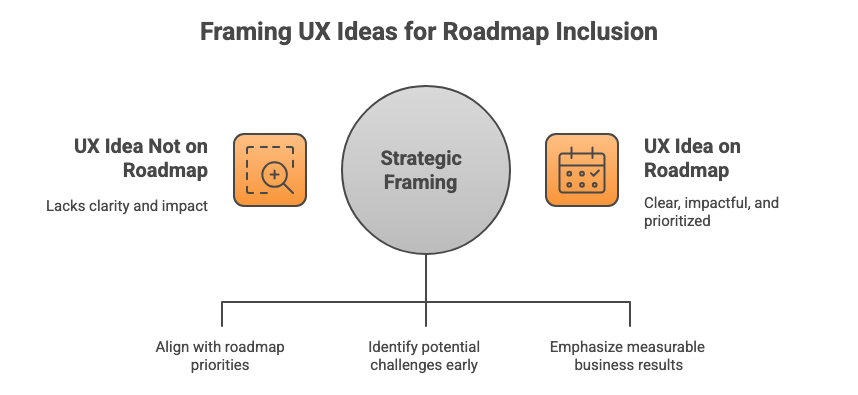
Roadmaps are built around priorities, risk, and outcomes. When your proposal speaks the language of clarity and impact, it earns a place.
This issue shows you how to shape a UX proposal so teams instantly understand why it matters and where it fits.
In This Issue
• Why UX proposals fail
• The four things every roadmap-ready proposal needs
• The UX Proposal Framework
• Real examples
• Common mistakes
• Take-Home Exercise
• Resource Corner
Why UX proposals fail
Most UX proposals fail for one of these reasons:
• They describe the solution but not the problem
• They feel disconnected from goals
• They include too many ideas at once
• They lack clear impact
• They feel like “nice-to-haves” instead of “must-dos”
Roadmap decisions rely on clarity and value.
Value means the measurable benefit a UX change creates, such as increased completion rates or reduced confusion.
If your proposal doesn’t surface value, it gets ignored.
UX is changing fast………..
Roles are shifting.
Expectations are higher.
And many professionals are quietly asking, “Where do I go from here?”

UXCON25 gave people clarity.
It surfaced the real conversations happening behind the scenes.
It showed what’s working, what’s not, and what the future is asking of us.
UXCON26 is where we take that understanding further.
Not just to connect, but to sharpen your thinking, strengthen your voice,
and help you navigate the next chapter of your UX career with confidence.
If you want to move with intention, not uncertainty,
join us at UXCON26.
The four things every roadmap-ready proposal needs
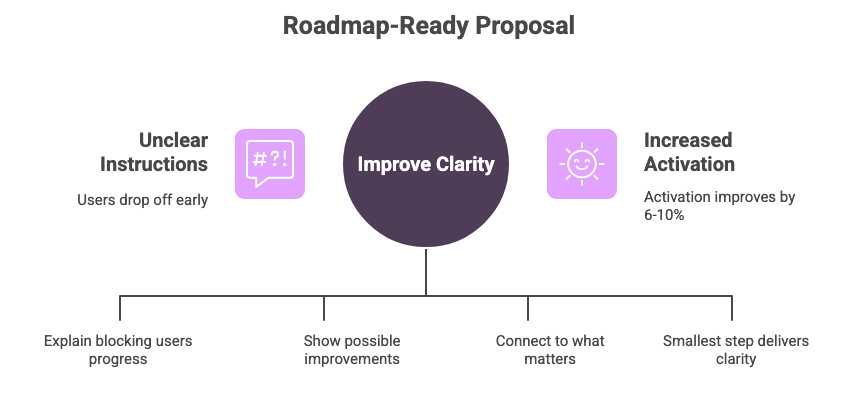
1. A crisp problem statement
A problem statement explains what is blocking users or slowing progress.
A problem means the specific friction causing failure or inefficiency.
Example:
“New users drop off at step one because the instructions feel unclear.”
2. A clear opportunity
An opportunity shows what becomes possible if the problem is solved.
An opportunity means the improvement or benefit created by a fix.
Example:
“Improving clarity could increase first-step completion and reduce early abandonment.”
3. A measurable outcome
An outcome shows how the proposal connects to what matters.
An outcome means the measurable result your change will influence.
Example:
“This fix could improve activation by 6 to 10 percent.”
4. A light, believable approach
No heavy documentation needed.
A light approach means the smallest meaningful step that can deliver clarity.
Example:
“A copy update and a short in-product hint. No structural changes.”
These four pieces turn your proposal into a clear business argument.
The UX Proposal Framework
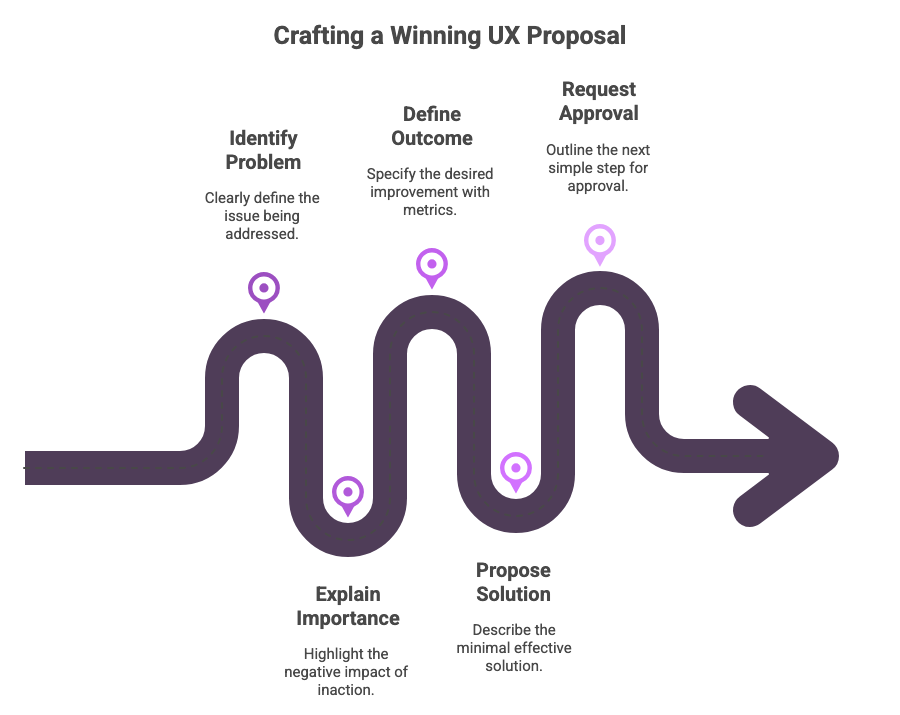
Use this 5-part script to write a roadmap-ready proposal.
1. What problem are we solving
One sentence. No fluff.
Example:
“People get stuck on the first step because they are unsure which option applies to them.”
2. Why this problem matters now
Explain the cost of doing nothing.
Cost means the negative effect created by the current friction.
Example:
“This causes early drop-off and reduces the number of people who reach activation.”
3. What outcome this proposal improves
Tie to a real metric, even if lightly estimated.
A metric means a number that tracks behavior or progress.
Example:
“Improving clarity could increase completion rates.”
4. The smallest strong move
Describe the minimal solution that produces meaningful learning.
A smallest strong move means the simplest change with the highest impact.
Example:
“A short explainer and improved labels. No new screens required.”
5. What you need to move forward
Make the next step simple.
A simple step means one clear action others can say yes to easily.
Example:
“If approved, I can prepare final copy and updated visuals by Thursday.”
Proposals win when they reduce effort, increase understanding, and show outcomes.
Examples
Example 1: Checkout hesitation
Problem: Users abandon checkout when a fee appears late.
Why it matters: Creates avoidable drop-off.
Outcome: Could recover lost orders.
Smallest strong move: Reveal fee earlier in the flow with a small layout shift.
Next step: Review and approve the updated design.
Example 2: Onboarding confusion
Problem: New users do not understand which choice fits their needs.
Why it matters: Causes 9 percent early drop-off.
Outcome: Could increase first-step completion.
Smallest strong move: Add a short one-sentence explainer.
Next step: Review copy options for clarity.
Example 3: Help content buried
Problem: Users cannot find answers during setup.
Why it matters: Creates support tickets.
Support tickets mean repeated questions users cannot solve themselves.
Outcome: Could reduce support load.
Smallest strong move: Add a visible “Need help” link near the task.
Next step: Validate placement with a quick usability test.
Common mistakes
• Writing proposals that are too long
• Presenting solutions without showing the pain
• Overestimating impact with no evidence
• Asking for large redesigns instead of small steps
• Using vague phrases like “improve usability”
• Not tying the proposal to an outcome
A roadmap is about priorities.
Clarity helps your idea rise to the top.
Take-Home Exercise
Use this exercise to turn any UX idea into a roadmap-ready proposal.
Step 1: Pick one UX pain point
Choose something small but meaningful.
Example: confusing label, hidden option, long explanation.
Step 2: Write a one-sentence problem statement
“What is blocking the user”
Step 3: Explain why the problem matters now
“What negative effect does it cause”
Step 4: Estimate the outcome
Even a small, believable estimate works.
“What improves if we fix it”
Step 5: Define the smallest strong move
“What is the simplest change that moves the needle”
Step 6: Write the proposal in 5 lines
Use the UX Proposal Framework.
This exercise builds a muscle that makes every proposal sharper and more influence-ready.
Resource Corner
How to define UX problems
https://www.nngroup.com/articles/problem-statements
Connecting UX work to outcomes
https://www.intercom.com/blog/product-principles
Final Thought
Roadmap influence is not about pushing ideas.
It is about framing them clearly.
When your proposal highlights the problem, the cost of leaving it unsolved, the outcome it improves, and the simplest path forward, people see its value instantly.
Clarity earns priority.
Priority earns a place on the roadmap.


