


OKRs are supposed to create focus, not chaos.
Yet many UX teams experience the opposite. They read the company OKRs, try to map their work, and suddenly everything becomes a priority. Everything feels connected. Everything feels important.
That is how scope creep starts.
This issue shows how to align UX work with OKRs in a clean, simple, predictable way. When you do this well, you protect your team’s focus and show leadership exactly how UX moves company goals forward.
In This Issue
• Why UX and OKRs get messy
• The three-step alignment method
• How to choose the right UX work for each OKR
• Real examples
• Common mistakes
• Resource Corner
• Final Thought
Why UX and OKRs get messy
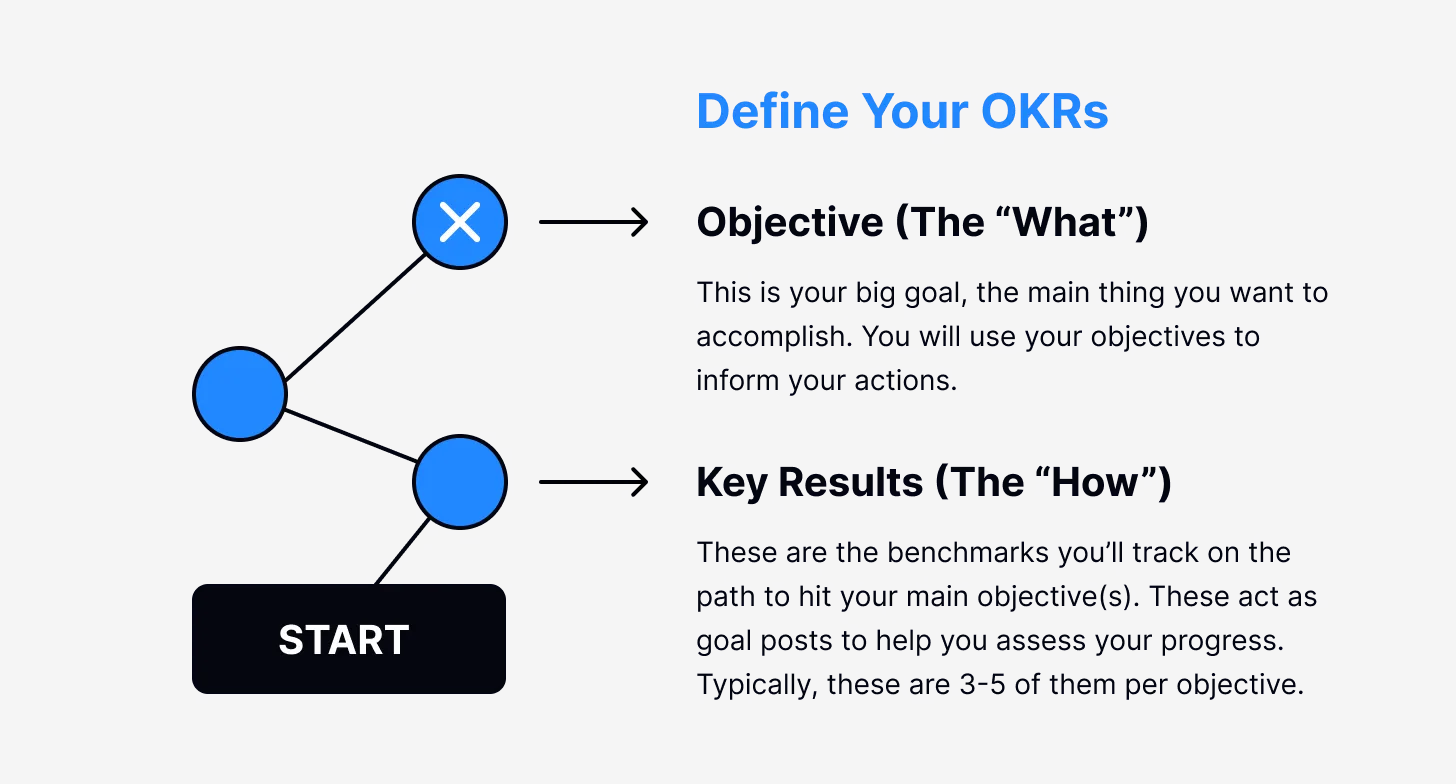
Objectives and key results (OKR, alternatively OKRs) is a goal-setting framework used by individuals, teams, and organizations to define measurable goals and track their outcomes.
OKRs are written at a company level.
They are broad by design.
Examples:
• Increase retention
• Improve customer trust
• Grow activation
• Reduce operational cost
UX professionals see these and immediately think of dozens of ways to help. But leaders like the CPO (Chief Product Officer) or COO (Chief Operating Officer) are not asking UX to do everything. They want the few UX moves that meaningfully shift the metric.
When UX tries to tackle the entire OKR, the team spreads too thin.
When UX picks focused, high-leverage work, everything moves faster.
The three-step alignment method
Use this method every time.
Step 1: Restate the OKR in user behavior terms
Example OKR: “Increase trial-to-paid conversion.”
User behavior translation: “More users must understand the value before the end of the trial.”
When you convert OKRs into behavior, the path becomes clearer.
Step 2: Identify the UX bottleneck that blocks the behavior
Example:
Users cannot find key product value in the first session.
This is the real friction behind the OKR.
Step 3: Choose the smallest UX move that shifts the bottleneck
Example:
“Redesign the first-run tooltip sequence to point users to the main value moment.”
This prevents scope creep because you are choosing leverage, not volume.
Hold up……
JOIN US AT UXCON26….. A quick look into the future
UXCON25 didn’t just bring people together.
It reminded many of us why our work matters in the first place.
It was the moment you heard a story that mirrored your own.
The moment a speaker said what you’ve been thinking for years.
The moment you finally understood where the industry is heading and where you fit in it.
For a lot of us, UXCON25 wasn’t about connection.
It was about clarity.
About redefining what success looks like in UX today. About seeing real career paths, real struggles, real wins, without the polished LinkedIn version of things.
And that’s the reason UXCON exists.
To help you make sense of an industry that’s evolving faster than ever.
To give you the tools, the mindset, and the confidence to move forward with purpose.
To show you what’s actually working in UX, and what’s quietly dying.
To help you build a career that is sustainable, respected, and aligned with where the world is going.
If you want to step into the next phase of your UX career with confidence and clarity, join us at UXCON26
back to where we stopped…..
How to choose the right UX work for each OKR
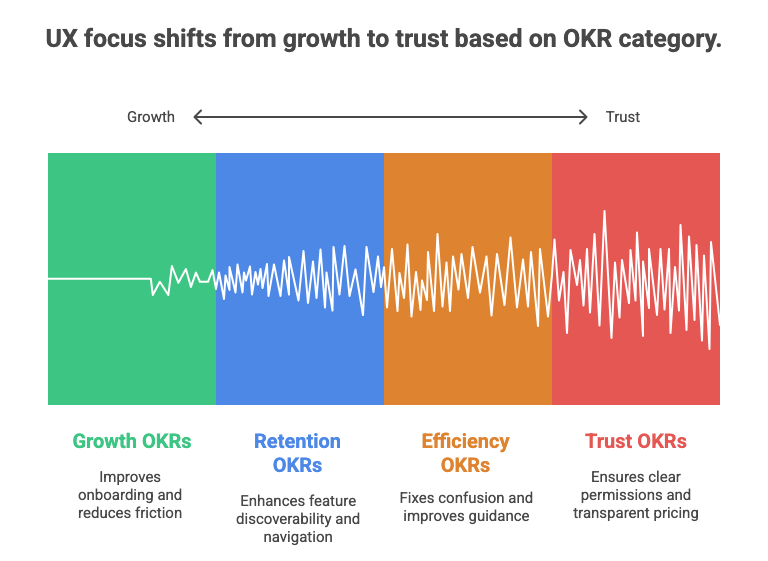
Here are the four most common OKR categories and how UX fits into each.
1. Growth OKRs (e.g., acquisition, activation, conversion)
Role that cares: CPO, who owns product growth.
UX focus:
• Onboarding clarity
• Reducing early friction
• Improving first-run success
These create measurable lifts without expanding scope.
2. Retention OKRs
Role that cares: CRO (Chief Revenue Officer) because retention protects predictable revenue.
UX focus:
• Feature discoverability
• Navigation clarity
• Reducing drop-off moments
Retention improves when users understand what is available and how to use it.
3. Efficiency OKRs (e.g., reducing support ticket load)
Role that cares: COO, who owns operational efficiency.
UX focus:
• Fixing high-confusion areas
• Improving help and guidance
• Reducing error states
Small UX improvements lead to fewer support calls and lower cost to serve.
4. Trust and compliance OKRs
Role that cares: CFO, because risk has financial consequences.
UX focus:
• Clear permission flows
• Transparent pricing
• Accessible copy and flows
Trust is built through clarity.
Real examples you can borrow
Example 1: Activation OKR
OKR: Increase new user activation.
User behavior: Users should complete three key actions in the first 10 minutes.
UX move: Highlight these actions with a simple progress guide.
Example 2: Reduce support volume
OKR: Cut support tickets by 15 percent.
User behavior: Users should be able to solve issues without contacting support.
UX move: Add a clear “Recent Orders” tab with visual status indicators.
Example 3: Increase mobile checkout conversion
OKR: Grow completed checkouts.
User behavior: Users should complete payment without confusion.
UX move: Simplify the payment screen and move optional elements lower.
Example 4: Improve billing transparency
OKR: Strengthen customer trust.
User behavior: Users should understand charges before finalizing.
UX move: Add a clear fee breakdown above the total.
Each one is small, focused, and tied to the OKR without adding unnecessary work.
Common mistakes
• Trying to support every part of an OKR
• Adding UX work that feels relevant but does not affect the metric
• Not defining the user behavior behind the OKR
• Acting without identifying the bottleneck
• Mixing nice-to-have improvements with outcome-focused work
Scope creep happens when UX expands work instead of concentrating leverage.
Resource Corner
UX OKRs: How to Set & Measure Achievable
How to Set UX OKRs: 15 Best Examples
What Is Scope Creep & How to Address It
Final Thought
UX becomes a strategic partner when it shows how small, focused changes shift the company’s biggest goals.
OKRs should not expand your workload. They should sharpen it.
Pick the UX work that moves the metric, not the entire mountain.
This is how you stay focused.
This is how you stay influential.


