


Quick Take
UX metrics are evolving. What worked in 2022 won’t carry us into 2026.
Teams are being asked to prove impact, not just effort.
The best UX metrics now connect user experience to real outcomes.
But first… JOIN US AT UXCON26
Walking into UXCON25, she expected conversations.
She walked out with clarity, perspective, and purpose.
What surprised her most wasn’t just the diversity of roles, it was the diversity of thinking. Leaders, practitioners, and innovators from across industries brought radically different approaches to UX. That exposure reshaped how she sees leadership, how she supports talent, and how a staffing and IT services business can genuinely serve the UX ecosystem.
🎟️ UXCON26 tickets are live, don’t just attend, evolve
Why UX Metrics Need a Reset
For years, many UX teams tracked the same familiar metrics:
Task success.
Time on task.
Satisfaction scores.
They’re not wrong.
But in 2026, they’re no longer enough on their own.
Stakeholders are asking harder questions:
Did this improve retention?
Did this reduce support tickets?
Did this help users succeed faster?
If UX metrics can’t answer those questions, UX risks becoming invisible again.
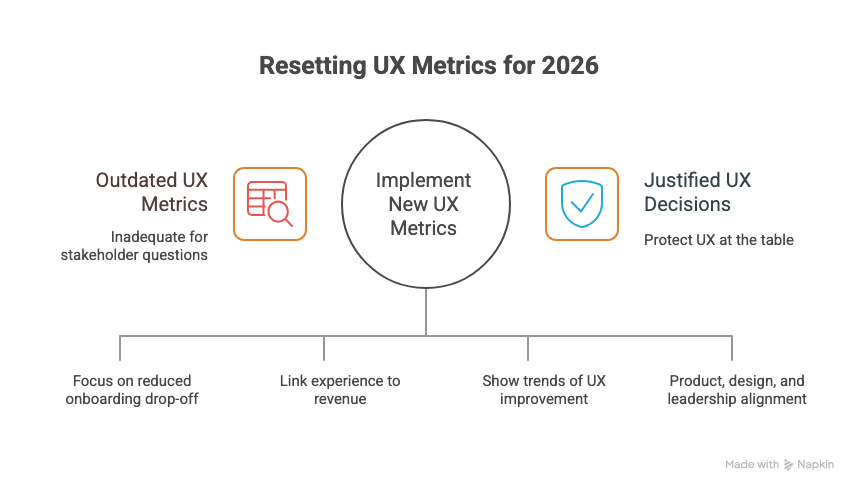
What UX Metrics That Matter Look Like Now
Outcome-based, not activity-based
Instead of “we ran 10 usability tests,” measure “we reduced onboarding drop-off by 18%.”Connected to business reality
Strong UX metrics link experience to revenue, adoption, efficiency, or trust.Tracked over time, not once
One usability score is a snapshot. Trends show whether UX is actually improving.Shared across teams
Metrics matter more when product, design, and leadership all look at the same signals.
Good UX metrics don’t just describe the experience.
They justify decisions and protect UX at the table.
UX Gameboard Challenge
Scenario
A UX team presents their quarterly report:
12 usability tests completed
4 surveys sent
Average satisfaction score: 4.3
Leadership asks one question:
“So… what changed because of this?”
The team struggles to answer.
Your Challenge
Identify 1 to 2 reasons why these UX metrics failed to influence leadership.
Suggest one UX metric that would better demonstrate real impact.
💬 Think you know the answer? Drop your thoughts in the comments - your response might be featured in next week’s Gameboard reveal!
Take-Home Exercise (10 minutes)
Pick one product or feature you work on.
Ask yourself:
What user behavior should improve if UX is working?
What metric would show that improvement clearly?
Now rewrite one existing UX metric you track into an outcome-based metric.
Example:
From “usability test completed”
To “checkout errors reduced after design changes.”
This shift is small, but powerful.
Why This Conversation Continues at UXCON26
In 2026, UX professionals won’t be judged by how well they design screens.
They’ll be judged by how clearly they show impact.
If you want to stay relevant, confident, and influential as UX evolves, this is a conversation you should be part of.
👉 Join us at UXCON26 and help shape what UX success looks like next.
Thanks for learning with us and pushing the UX discipline forward.
See you next Wednesday.
– The UXU team


